

Bitcoin Myths, Part 1
Most Bitcoin Objections Don't Hold Up

No Coiner Nonsense
There is a special breed of people who hate Bitcoin. They are convinced it will fail any day now. They call it a scam, a bubble, a fad, a danger to society, and whatever else pops into their heads.
These folks do not want you buying Bitcoin and they repeat the same tired myths again and again. This article is not about the arguments that deserve real discussion. It is about the ones so ridiculous you can only laugh and say “OK Boomer.”
Here are the greatest hits of no coiner nonsense
Argument 1: Bitcoin is backed by fiat money
I saw this one in a Quora comment. I wish I could drag it back up from the dregs of the internet, but trust me, it was real. You cannot make this stuff up.
The wackiest thing about crypto is that it disdains the fiat currency issue by governments that is backed by nothing concrete like gold, yet what is it that backs the crypto? Those very fiat currencies used to purchase it.
This person clearly has no idea what the phrase “backed by” means. Being backed by something means the asset has value because an institution is legally required to exchange it for something else of value. In the old days the U.S. dollar was backed by gold. Foreign banks could bring dollars to the United States and the Federal government had to hand over gold at a fixed rate. 1 That is what “backed by” means.
Can you buy Bitcoin with dollars? Yes. Can you sell Bitcoin for dollars? Yes. But there is no institution on earth that is legally required to give you dollars for your Bitcoin. That is not backing. That is simply a free market. It is no different from using dollars to discover the price of gold. Buying gold with dollars does not mean gold is backed by the dollar. Gold stands on its own.
Bitcoin works the same way. The dollar is a measuring stick, not Bitcoin’s source of value.
Argument 2: Bitcoin is Tulip Mania
People used to argue that Bitcoin was just another Tulip Mania. This comparison made sense back in 2011 when Bitcoin had its first explosive bull run. Many saw the rising price and assumed it would pop once and disappear forever.
But history did not play out that way. Bitcoin has bubbled and crashed at least four major times. Each time it fell hard. And each time it came back stronger. If Bitcoin were destined to die like a true mania, it would have stayed dead after the first collapse.
Now compare this to something that really did follow the Tulip pattern. Look at Beanie Babies. 2 In the early 1990s the bears sold for about five dollars. Then the late 1990s mania hit and certain popular or rare ones resold for hundreds, and a few ultra-rare versions even reached the thousands. When the bubble popped around 1999 to 2001 the prices collapsed and never returned. Today almost nobody cares about them and the market has been flat for more than twenty years.
This is the key point. True manias collapse once and stay collapsed. Bitcoin does not behave this way. It crashes and then rebuilds new highs after every cycle. Beanie Babies and tulips never did. They had one hype cycle. Bitcoin has had several.
Let’s look at some charts to make this even more clear.
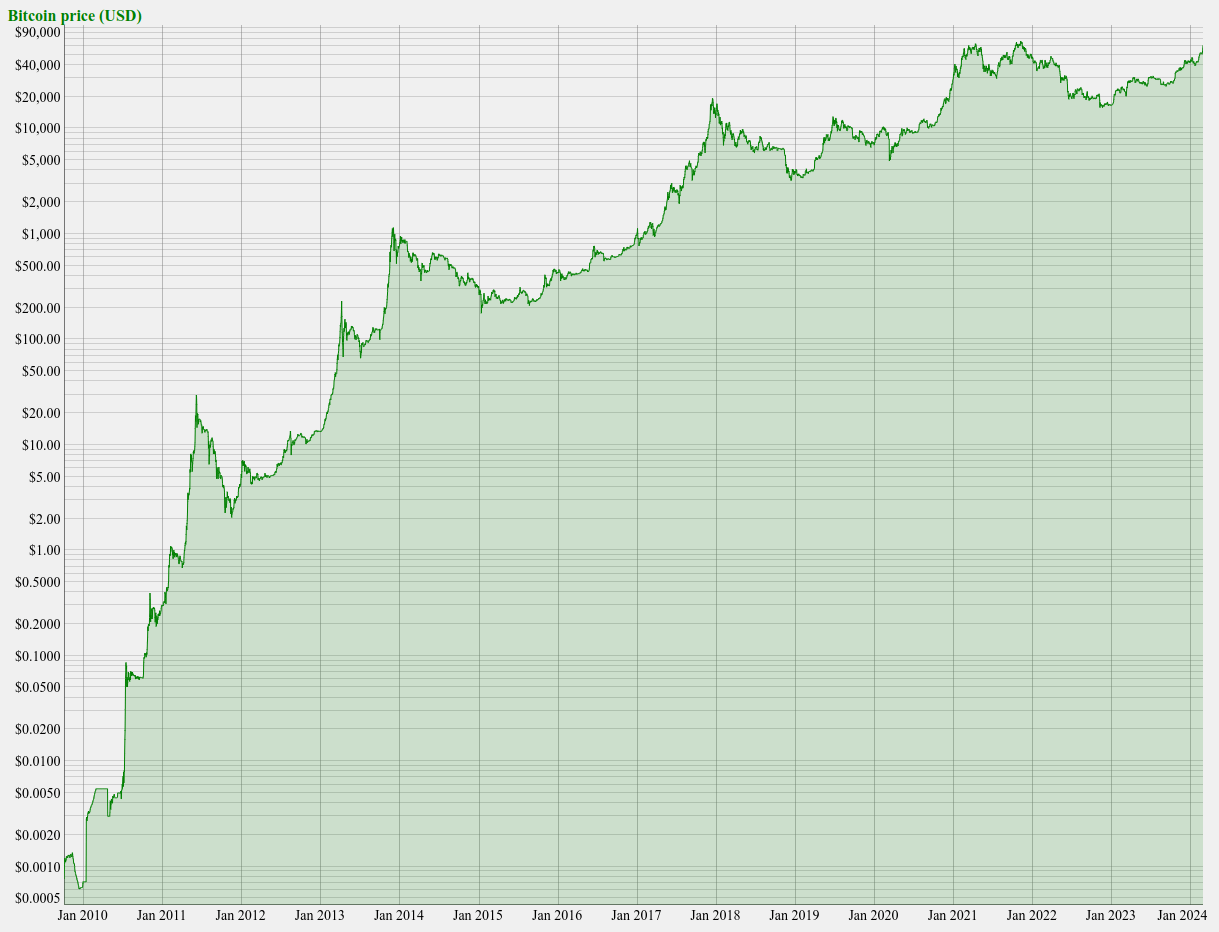
Here is Bitcoin’s price chart. 3 You will see huge dips and some of them look terrifying at first glance. In late 2011 Bitcoin fell from about twenty dollars to just two dollars. If Bitcoin was a true mania like Beanie Babies it would have died right there. Instead the price recovered, reached new highs, and did it again and again. This is the opposite of a one-time bubble.
Now look at the Beanie Babies. I used ChatGPT to help visualize this chart, but it is based on my research into prices for common Beanie Babies. You can see the spike in the late 1990s followed by a total collapse that never recovered. That is what people mean when they talk about Tulip Mania. A few rare Beanie Babies still hold value as collector items, but this chart shows the overall common market, which peaked once and then stayed flat for more than twenty years.

A real mania only dies once. Beanie Babies died once and stayed dead. Bitcoin has “died” hundreds of times according to headlines, blogs, and experts, yet it keeps coming back. In fact, people have declared Bitcoin dead more than 440 times. 4 Anything that can die 440 times and still live is not a mania. It is immortal.
Governments Will Shut Bitcoin Down
If the government was able to shut down Bitcoin, they would have done it back in 2011 when they took down the Silk Road. The Silk Road was an online marketplace for illegal drugs, and it stayed hidden partly because it used Bitcoin instead of traceable payment services like PayPal. When the FBI investigated the site, they considered whether Bitcoin itself could be stopped. Once they understood how decentralized the network truly is, they realized it could not be shut down. So they focused on what they could control. They arrested the site’s creator, Ross Ulbricht, and shut down the website. 5
Bitcoin is mined around the world and is supported by a decentralized network that no single government controls. To shut it down would require an extremely expensive nation-state attack that could cost billions and still fail. The only other option would be for every government on earth to criminalize mining and coordinate a global crackdown. That level of cooperation is impossible, and even if it happened an underground mining network would reappear.
A government can make Bitcoin illegal to use, but that only drives it into the black market. It is the same effect you see when marijuana is outlawed. Unless a country is willing to go full Singapore with enforcement, it only increases the value of the banned item. Some people also worry about quantum computers taking down Bitcoin, but if quantum cryptography ever becomes powerful enough to break Bitcoin’s security, every bank, government, and internet service will be broken too. At that point, Bitcoin would be the least of our problems.
There are more No-Coiner myths than I can fit in one post, so stay tuned for next week’s Bitcoin Myths.
Final Word
Don’t get taken in by No-Coiner myths.
“The trouble with the world is that the stupid are cocksure and the intelligent are full of doubt.” — Bertrand Russell
DISCLAIMER: This article is for informational and educational purposes only and should not be construed as financial, investment, tax, or legal advice. The author is not a licensed financial advisor, and nothing in this article constitutes a recommendation to buy, sell, or hold any cryptocurrency, gold, or other asset. Cryptocurrency investments are highly volatile and risky, and you could lose all of your invested capital. Past performance does not guarantee future results. Always conduct your own research and consult with a qualified financial advisor before making any investment decisions. The author operates a paid cryptocurrency education course and may hold positions in assets discussed.
https://www.investopedia.com/ask/answers/09/gold-standard.asp
https://thehustle.co/the-great-beanie-baby-bubble-of-99
https://bitcoin.zorinaq.com/price/?
https://bitcoindeaths.com/
https://www.chainalysis.com/blog/james-zhong-silk-road-hack-seizure/
Thank you. I appreciate this comment.
I would like to write more on why governments can't shut down Bitcoin. This article focused on some of the more weak no-coiner arguments. I think I could write articles on Bitcoin myths once per week for a year and not run out of material. And I might if there’s enough demand for it.