

Gold vs Bitcoin, Part 5
Civilization Outgrew Gold

For thousands of years gold was the currency of kings. It’s beautiful, rust resistant, difficult to counterfeit, and hard to pull from the Earth. The Egyptians trusted it. So did the medieval world. Gold seemed like the perfect form of money.
Until civilization outgrew it.
The Banking Revolution
In the medieval era the Italians pioneered what eventually became modern banking. 1 Merchants could deposit gold in one city, receive paper claims in return, and then travel across Europe using those claims to access their wealth in distant lands. A merchant from Venice could arrive in London carrying notes instead of chests filled with metal.
Before banking, moving wealth across Europe was slow, expensive, and dangerous. Gold had to be physically loaded onto ships and wagons, then guarded as it crossed oceans and borders. Imagine transporting 1,000 pounds of gold from Venice to London. One storm or pirate attack could wipe out a fortune.
Even if the shipment arrived safely, the process was painfully slow. Imagine you are a merchant in Amsterdam trying to buy a business in Venice. First you send instructions by letter. Then the gold is loaded onto a ship and begins its journey across Europe.
How long would settlement take? Months.
Medieval Europe was filled with competing currencies. Different kingdoms minted different coins with varying gold content, and many rulers quietly mixed cheaper metals into their money. Counterfeiting was common as well, forcing merchants to constantly verify whether coins were genuine and what they were actually worth.
Banks simplified the process. A merchant could present a bank note and receive trusted local currency in return.
Banking made commerce easier in general. At first merchants redeemed notes for physical gold before making purchases. But over time something changed. Businesses simply started accepting the bank notes directly as payment.
You no longer needed to carry a heavy bag of coins on your hip all day. Instead, you carried notes in your pocket while the gold itself stayed locked away in vaults.
The Consequences
At first it was an incredible innovation. Banking made commerce faster and more efficient than ever before. But it also changed how people thought about money. Merchants stopped handling gold directly and began trading paper claims instead.
Eventually, they simply assumed the gold was there.
This led to fractional reserve banking. 2 Bankers realized that most depositors rarely withdrew their gold at the same time. So instead of letting the metal sit untouched in vaults, banks began lending it out.
As long as confidence held, the system functioned smoothly.
But when trust failed, bank runs followed. Panic spread quickly through economies, banks collapsed, and depressions followed.
Eventually confidence returned, new banks formed, and the cycle began again.
In the 1600s, merchants could take paper claims to a bank and receive physical gold in return. By the 1800s, nations had formalized these systems into official gold standards. Britain led the way in 1821, 3 and the United States followed soon after.
It seemed like the perfect balance between hard money and modern finance.
But the balance did not last.
By the 1930s, governments across the world stopped allowing ordinary citizens to exchange paper money for physical gold.
By the 1940s the gold standard was reserved for nation states rather than ordinary citizens. The United States accumulated massive gold reserves and, under the Bretton Woods system, positioned the dollar as the global reserve currency. 4 But even this system could not last. In 1971, President Nixon ended the dollar’s direct convertibility into gold. 5 For the first time in modern history, the global financial system was no longer formally tied to gold. Money now depended on trust in governments and central banks.
Why Don’t We Go Back to Gold?
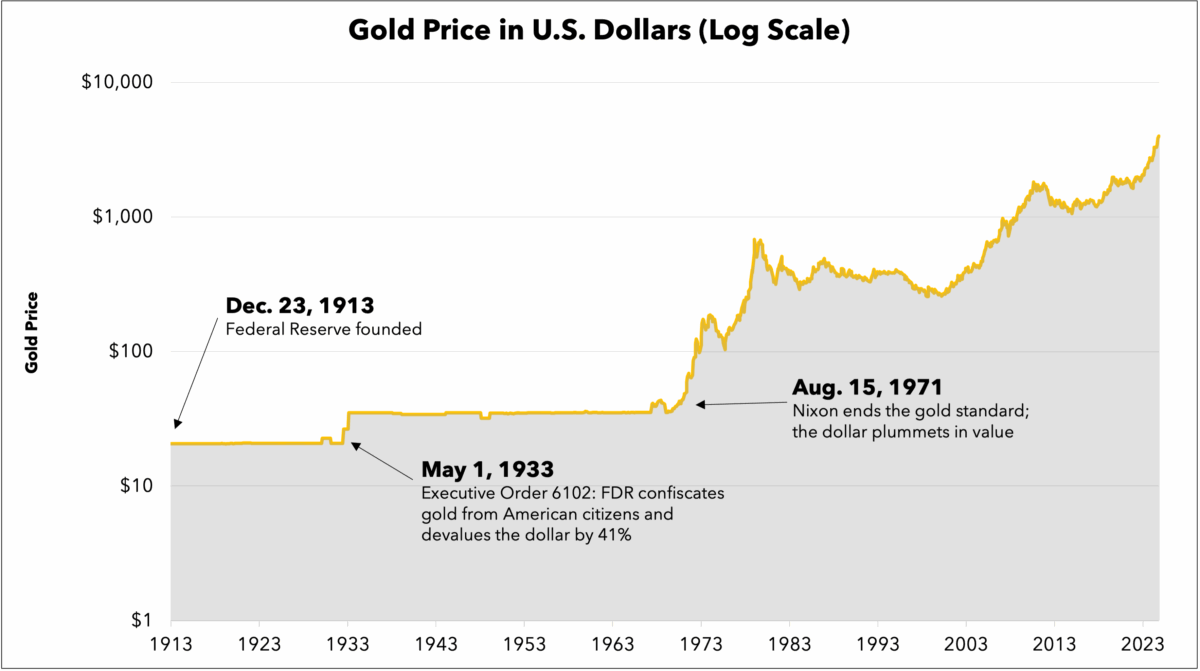
I agree that gold is a better store of value than fiat currency. It doesn’t take a genius to see that. Compare the value of gold to the purchasing power of the dollar since 1913. 6
But modern finance is built around speed, scale, and global coordination. We can wire money across the world in seconds, run international businesses, and buy products online instantly. Physical gold cannot move at the speed modern commerce demands.
And the idea that we will return to a gold-backed currency is unlikely. We already spent centuries building financial systems designed to move faster than physical gold allows. There is no easy path backward.
This is not the result of some grand conspiracy to pull humanity away from sound money. Banking evolved because it solved real problems: distance, security, speed, and coordination.
If sound money ever returns, it won’t be through gold.
Maybe Bitcoin?
Final Word
Gold lost its status because it couldn’t keep up with the modern world.
“The lack of sound money is one of the greatest economic disturbances of our time.” — Friedrich Hayek
End of the Series. Beginning of a Book
This is the final article in my Gold vs Bitcoin series, but it is only the beginning of a much larger project.
I am currently turning these ideas into a full book covering the history of money, banking, fiat currency, and Bitcoin’s potential role in the future of money.
Paid subscribers will receive both a digital and physical copy of the book when it launches.
https://accentglobal.com/newsletters/issue-n25/old-money-the-history-of-banking-in-florence/
https://www.investopedia.com/terms/f/fractionalreservebanking.asp
https://www.britannica.com/money/gold-standard
https://www.investopedia.com/terms/b/brettonwoodsagreement.asp
https://www.federalreservehistory.org/essays/gold-convertibility-ends
https://vaulted.com/nuggets/gold-and-the-dollar-a-breakup-story/
A 'like' for your excellent writing... however, I disagree somewhat. I do agree with you that a gold-backed currency will lead to the same old problems. I do agree with you that gold is still fakeable. So how do I disagree? This warrants an article.