

Open Source Vs Proprietary
Why Bitcoin Is Open Source but Banks Are Not

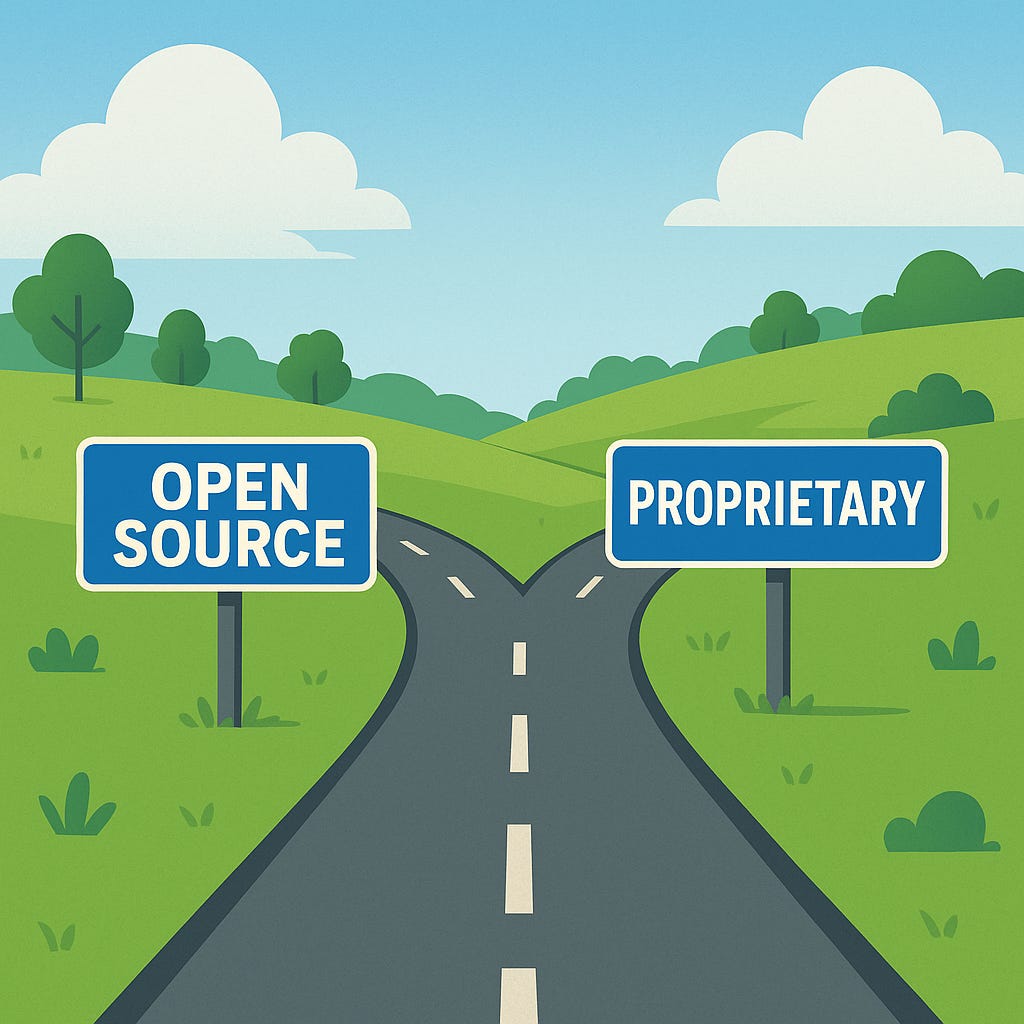
Two Roads Diverged: Open Source vs. Proprietary
There are two paths for making software.
One is open source, where you give the code away for free. Anyone can see what you built, and anyone can use it.
The other is proprietary, where you charge users for access, hide the code, and keep full control over how it is used.
Cryptocurrencies like Bitcoin and Ethereum follow the open-source model. Anyone can check, copy, or fork the code (make a version with changes) and build apps on top of it or alongside it.
Banks and payment apps like PayPal are proprietary. You cannot see their code, use it, or build on top of it without permission.
There are advantages and disadvantages to both, and I will not pretend proprietary software does not have its strengths.
If you run a software company, it is easier to focus your team, charge for your product, and keep potential attackers from seeing vulnerabilities.
But I believe open source is ultimately superior, and Linux has already proven it.
Linux Already Took Over the World
Did you know that Linux has quietly taken over nearly everything?
Over 90% of public cloud systems run on Linux-based infrastructure 1
Linux powers 100% of the world’s top 500 supercomputers 2
More than 57% of all websites run on Linux 3
Around 46% of embedded devices use Linux 4
Android, which is Linux-based, runs about 70% of the world’s smartphones 5
And Linux still holds about 3% of the desktop market, with Chrome OS adding another 1% 6
Not bad for free software, right?
The Problem with Proprietary Software
These stats show that open source can be incredibly successful, but that does not automatically prove it is better than proprietary software. In some ways, proprietary systems do have real advantages:
They can update faster
They generate revenue more easily
They give the creator tighter control
But that control comes with a cost, and it often leads to mistakes that open source systems can easily correct.
Anyone can make their own version of Linux.
If the team behind Linux Mint (a popular, user-friendly distribution) releases an update everyone hates, users are not stuck. They can simply switch to another distro or even make their own, and Mint cannot stop them.
But if Microsoft releases Windows 11 and your computer does not meet the new hardware requirements, you are out of luck. Your perfectly good machine might be blocked from updating. Meanwhile, you get forced ads, invasive telemetry, and unwanted AI features.
Now you face a tough choice:
Keep obeying the system or move to something unfamiliar. Many users are clinging to Windows 10 (even though support ends soon) or finally switching to Linux, the smarter move.
Open source software could never pull this stunt. The community would revolt, developers would fork the code, and an alternative would immediately emerge.
Proprietary software does not give you that freedom. If the company decides to tighten control, you have to comply or start over.
What This Has to Do With Bitcoin
Simply put, Bitcoin is open source, and the banking and fiat system is proprietary.
If you do not like Bitcoin, you can fork it, improve it, or build your own. That is why Bitcoin Cash, Litecoin, and thousands of other projects exist.
If you do not like the fiat system, you are stuck with whatever policies the central banks decide.
The most you can do is change “operating systems” and move to crypto. Otherwise, you have to swallow the pain and follow their rules.
Which road will you choose?
I choose open source.
Final Word
Thank you for learning about Open Source Software.
I shall be telling this with a sigh
Somewhere ages and ages hence:
Two roads diverged in a wood, and I—
I took the one less traveled by,
And that has made all the difference.
— Robert Frost
DISCLAIMER: This article is for informational and educational purposes only and should not be construed as financial, investment, tax, or legal advice. The author is not a licensed financial advisor, and nothing in this article constitutes a recommendation to buy, sell, or hold any cryptocurrency, gold, or other asset. Cryptocurrency investments are highly volatile and risky, and you could lose all of your invested capital. Past performance does not guarantee future results. Always conduct your own research and consult with a qualified financial advisor before making any investment decisions. The author operates a paid cryptocurrency education course and may hold positions in assets discussed.
enterpriseappstoday.com/stats/technology-and-innovation
https://www.linuxfoundation.org/blog/blog/linux-runs-all-of-the-worlds-fastest-supercomputers
https://www.amraandelma.com/linux-marketing-statistics/
https://electroiq.com/stats/embedded-systems-statistics
https://gs.statcounter.com/os-market-share/mobile/worldwide
https://gs.statcounter.com/os-market-share/desktop/worldwide/
Love this article. Im an open source all the way and believe that all software (for those people that started building software) always had the best intentions to make it available for all. At least in "early internet days". Think Mozilla Firefox or Thunderbird, or GIT. One of the best source control softwares IMO. These are great examples of open source software that people still use today that had a driving community. I think ultimately capitalism ends up coming in and taking over. It's so sad. But the future should be open source. I actually was talking about this in my latest article. Anyways im ranting. Love this take Jared.
Really enjoyed your analysis of open source vs proprietary software. From my perspective, highlighting the freedom and adaptability of open-source systems is key to understanding why projects like Bitcoin can thrive. Curious what you think about the trade-offs between community-driven development and the speed or efficiency that proprietary control can sometimes offer?