

The Marks of a Healthy Crypto Community Part 4
Five Elements of a Healthy Crypto Community

I used to work in the oil fields in North Dakota, and you would be surprised how many guys I knew who were missing a finger. It was scary.
One rig I worked on had a series of safety signs about it.
The first sign said, “This machine has no brain. You must use your own.”
The next sign showed a guy missing his middle finger. The caption said, “Now how will he be able to tell people what he really thinks?”
The next sign showed a man missing his thumb. It said, “Not a thumbs-up situation, is it?”
Nothing makes you appreciate your hands quite like imagining them getting smashed by a thousand-pound pipe. And it also makes you realize something else. Hands work because all five fingers are there. Lose one and the hand still exists, but using tools suddenly becomes a lot harder.
Fortunately, I never lost any digits, which means I can still type my Crypto Confidence articles just fine.
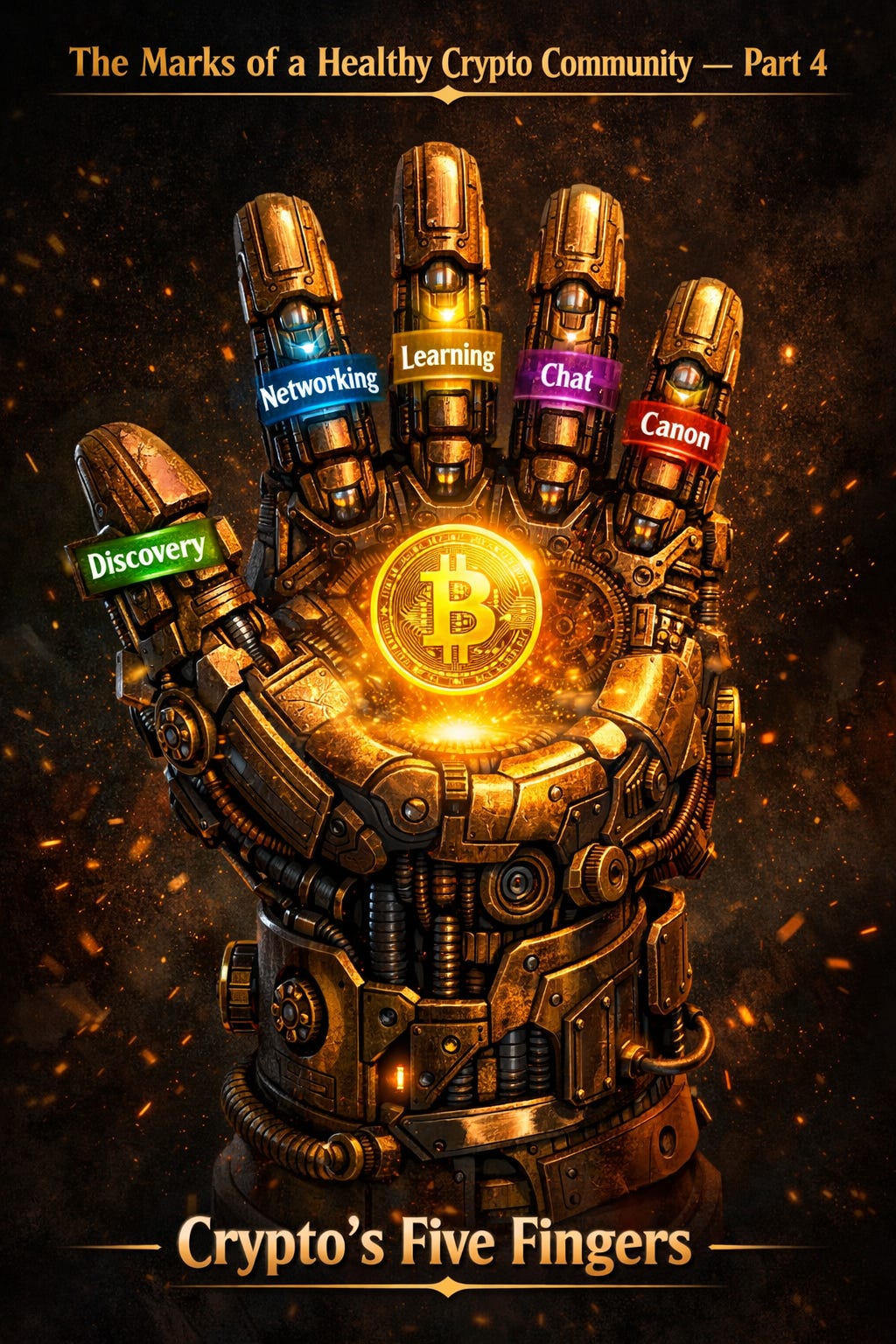
But thinking about those signs got me thinking about something else. The crypto community needs five fingers too.
Crypto’s Five Fingers
Successful crypto communities have five fingers.
It’s possible to operate with less, but their grip on the community is much more likely to slip when a bear market smacks the hand.
The strongest communities have all five.
Growth/Discovery. This is the obvious one. It’s how people find crypto projects online. Think about a TikTok video or an X post that grabs your attention and sends you down a rabbit hole. That’s discovery.
If people don’t know the project exists, nothing else matters.
Networking. This doesn’t mean gaining followers or attracting users. It means building relationships that help the project grow. Think partnerships, integrations, investors, advisors, and other builders in the ecosystem.
Learning. These are posts primarily meant to educate users. The best ones are usually long-form articles or deep YouTube videos. Without knowledge, the people perish.
Chat. People need a place to talk about the project in real time and voice their thoughts to community leaders. Without this, there is no community connection, and complaints spill into the comments on X instead.
Canon. This finger is missing most often. Users need a place where posts become the permanent record of the project and the official source of truth.
It creates a timeline the community can go back through to understand the project’s vision and philosophy.
Which Social Media Platforms?
Different platforms specialize in different fingers. Here are some of the most common and what they do best.
X. Best for discovery. It can also support some networking and learning when used well.
TikTok. Great for discovery and not much else.
LinkedIn. Excels at networking and discovery.
YouTube. Excellent for learning and also strong for discovery.
Medium. Works well for learning and canon, though distribution can be inconsistent.
Substack. Great for learning and canon. The email distribution helps people actually see the content, while the blog archive makes it permanent and easy to revisit.
Discord. One of the major chat platforms. Its structured channels make it easy to organize conversations, though that structure can also make projects treat it like a support desk.
Telegram. The other major chat platform. Conversations move faster and feel more like a public square, which often attracts a more old-school crypto crowd.
Website blog / Email newsletter. Can function as canon if the project maintains it consistently.
Mirror.xyz. A crypto-native platform designed for canon.
GitHub. Canon for developers.
Reddit. A mix of discovery and chat, though the communities usually control the conversation rather than the project itself.
This list is a quick way to see whether a project has all five fingers. For example, imagine a project is only active on X, YouTube, and Discord. That means it has discovery, learning, and chat, but networking may be weak and canon may be missing entirely.
When you evaluate a crypto project, pay attention to the platforms it uses and whether all five fingers are present. If one is missing, that is something to keep in mind.
Bitcoin The Classic Example
Bitcoin launched in 2009 so its tools were completely different but it still had all five fingers.
Discovery. Bitcoin’s discovery started when Satoshi emailed the Bitcoin whitepaper to the cypherpunk mailing list in 2008. 1 Early awareness spread through email forwarding, forum discussions, and word of mouth within that small cryptography community.
Networking. The same mailing list also functioned as Bitcoin’s first networking layer. The cypherpunk community already contained cryptographers, developers, and thinkers interested in digital money. That existing network gave Bitcoin its first collaborators, critics, and builders.
Learning. Bitcoin’s first learning resource was the Bitcoin whitepaper itself. 2Unlike today’s crypto projects, the early audience didn’t need beginner tutorials. The cypherpunks reading it were already familiar with digital cash proposals, cryptography, and the problems Bitcoin was trying to solve.
Chat. Early conversation about Bitcoin took place on forums like Bitcointalk.org. 3This gave the community a place to ask questions, debate ideas, and discuss the project as it evolved. It also allowed users to complain about problems, suggest improvements, and even ask Satoshi himself for help and clarification.
Canon. Bitcoin’s canon formed through the original whitepaper and the archived discussions on Bitcointalk.org. Because those conversations are preserved, people can still comb through them today to see how the project evolved and understand its guiding principles.
Looking back, it’s remarkable how simple Bitcoin’s tools were. An email list and a message board carried the entire early community.
Conclusion
If you’re considering holding a token long term, evaluate the strength of the community behind it. Make sure the project’s hand is strong and every finger is accounted for. When the market turns, a project missing a finger could lose its grip.
Final Thought
Just as I never thought about my fingers until I contemplated losing them, I never thought much about crypto communities until I realized how fragile they can be.
“The whole is greater than the sum of its parts.” — Aristotle.
Disclaimer:
The information in this publication is for educational purposes only and does not constitute financial, investment, or legal advice. Always do your own research before making any financial decisions. Cryptocurrency investments carry risk, and past performance is not indicative of future results. I actively invest and trade in the crypto markets, and my personal portfolio and holdings change frequently. Nothing I share should be interpreted as a guarantee of performance or a recommendation to buy or sell any asset.
https://www.metzdowd.com/pipermail/cryptography/2008-October/014810.html
https://bitcoin.org/bitcoin.pdf
https://bitcointalk.org/
For the 'canon' finger, the Satoshi Nakamoto Institute had a big influence on me. It's a good website.