

Wall Street, Move Over
How Blockchain Replaces Wall Street’s Outdated Infrastructure

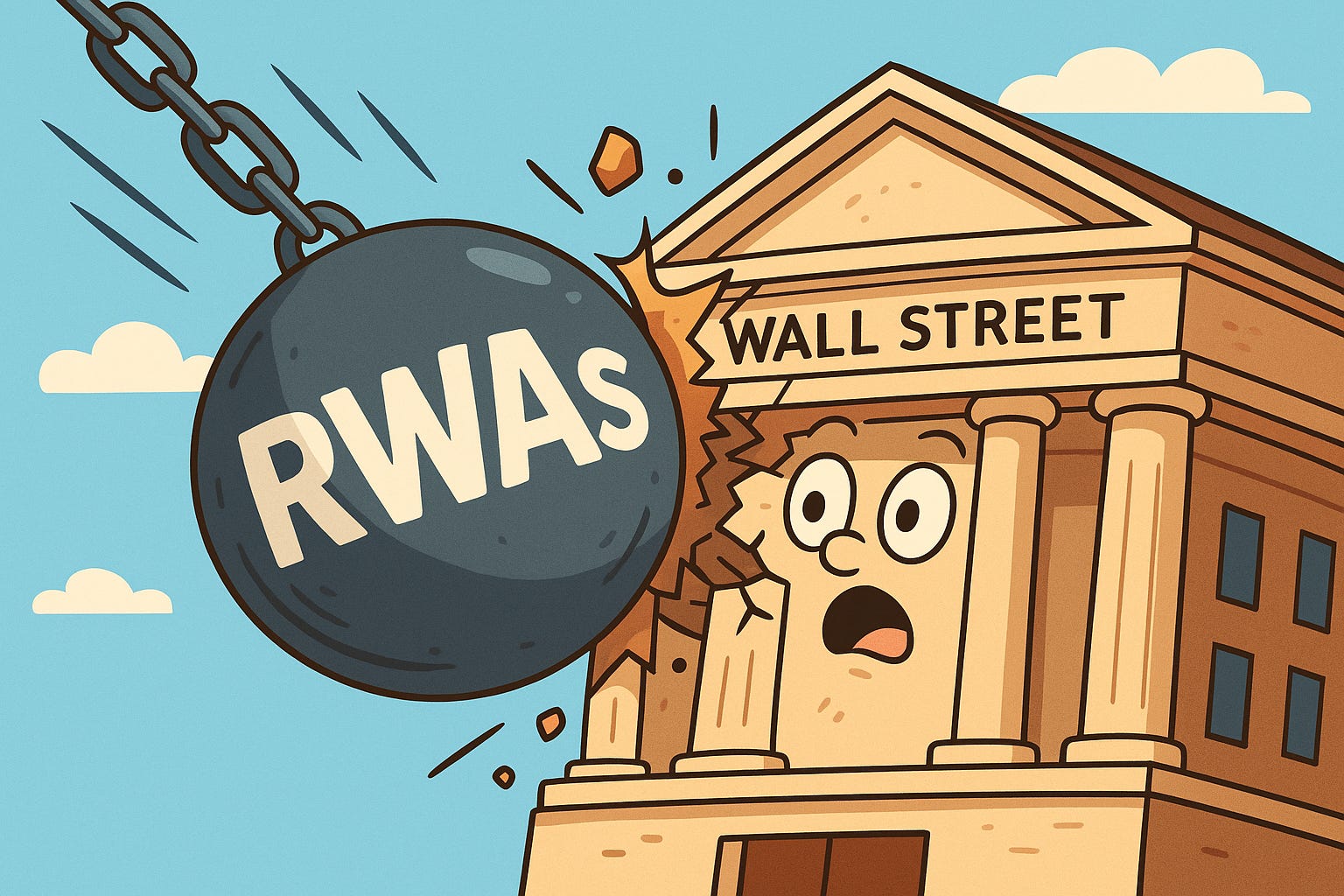
Many people argue that blockchain is a solution searching for a problem and that it will never find real use cases. I disagree. There are plenty of problems that urgently need blockchain, and one of the clearest examples is Wall Street. Real World Assets (RWAs) like stocks, bonds, and other financial products are still held together by outdated systems. Traditional exchanges have failed to modernize in meaningful ways, and blockchain technology is in a strong position to take over.
What Problems Will Blockchain Solve for Traditional Finance?
Let’s take a look at a variety of problems that blockchain can solve for traditional finance.
Limited Access Outside Banking Hours
Traditional financial markets are only open during narrow bank hours. This may work well for institutions, but it creates real problems for retail traders who cannot sit in front of a screen from 9:30 AM to 4 PM EST. Limited trading windows restrict access, prevent people with nontraditional schedules from participating, and keep retail from reacting to global news in real time.
The most damaging effect is timing. When bad news breaks after markets close, institutions can immediately hedge or reposition through futures, international markets, and private venues like dark pools or internal crossing networks. Retail investors cannot. By the time markets reopen, prices have often already adjusted, leaving retail to sell into sharp declines rather than exit when the news first appeared. This effectively puts retail at the back of the line during market stress, increasing the likelihood of worse execution and larger losses.
Blockchain-based markets can help level this playing field by allowing continuous access and real-time price discovery. Some may argue this reduces institutional advantages, but fair and transparent rules strengthen trust across the entire system. When investors believe losses are caused by unequal access rather than risk itself, political pressure for heavier regulation and punitive oversight is rarely far behind.
Custodial Risk and the Illusion of Ownership
In traditional markets, a custodian holds and manages stocks on behalf of investors. Platforms like Robinhood give the appearance of control by allowing users to place buy and sell orders, but ultimate authority still rests with intermediaries that execute, clear, and settle trades. When GameStop shares surged and threatened large institutional short positions, trading was temporarily restricted. 1 That episode made it clear that retail access is conditional and can be revoked when market outcomes become inconvenient for powerful participants.
A system where investors hold the cryptographic keys to their stocks and other financial assets changes this dynamic entirely. Ownership is no longer permissioned by brokers, clearinghouses, or centralized platforms. Transactions can settle directly between participants, making it far more difficult for governments or large financial institutions to intervene selectively and decide who is allowed to trade. This is not about eliminating rules. It is about enforcing them equally. When markets operate under visibly unequal access, trust collapses. And when trust collapses, capital formation, participation, and belief in the legitimacy of capitalism itself begin to break down.
Hidden Risk in Opaque Markets
Traditional finance is well known for opaque data. Even large institutions often struggle to understand what is happening across the market because information is fragmented and not widely shared. Corporations tend to obscure the assets they hold and rarely provide transparent, real-time insight into their positions. In some cases, it is understandable that an institution would not want its full strategy visible to the public.
However, this opacity also increases the likelihood of black swan events. Structural risk is much harder to identify when market data is hidden or delayed. Many analysts now believe the 2008 financial crisis was not caused solely by flawed products, but by a lack of reliable, shared data. Even major institutions did not fully understand the scale of the risk until it was too late. 2
This is why open and public blockchains that reveal market structure to anyone who wants to examine it are so important. Transparency does not eliminate risk, but it prevents market participants from operating blind and allows problems to surface before they become systemic.
Blockchain offers many additional benefits for RWAs, but these three alone justify its adoption.
RWA Market Developments
The good news is that RWAs are not just compelling in theory, but are already seeing adoption. Here are three recent developments that show how quickly blockchain technology in traditional finance is gaining traction.
Uphold Moves Toward Tokenized Securities With tZERO
Uphold is one of the larger crypto platforms globally, serving more than 10 million users. The company has recently filed an application with FINRA to offer tokenized securities to its customers. 3 The initial focus is expected to be on trading shares of private companies rather than publicly listed stocks. This does not mean large, established firms like Apple, but smaller, higher-risk startups that also carry higher potential upside.
Uphold is not pursuing this alone and is partnering with tZERO to provide the regulatory framework and infrastructure needed to support tokenized securities. If approved, this integration could open access to private company shares for a broader audience and introduce liquidity into a market that has historically been illiquid. The initiative remains highly regulated, and tokenized securities are not expected to launch until late 2026.
SEC Is No Longer Opposed to Tokenization
The SEC has already signaled that it will allow a limited degree of tokenization within DTCC’s infrastructure. While the initiative remains highly regulated and explicitly experimental, it marks a clear shift in regulatory posture. Rather than prohibiting blockchain technology outright, the SEC is now allowing it to be tested within traditional market systems under strict oversight. 4
Kraken Partners With Deutsche Börse
Kraken is one of the largest cryptocurrency exchanges in the United States, with roughly 15 million users and a significant European presence. Kraken has partnered with Deutsche Börse to enable institutions to offer Real World Assets while benefiting from blockchain-based infrastructure. Kraken has built the underlying technology and is now offering it to major institutions as a white-label solution. While it will take time for these advantages to reach retail users, the partnership is a strong signal that broader adoption is underway. 5
Conclusion
All three of these developments occurred in December 2025. Together, they show that Real World Assets are already moving from concept to implementation, and that millions of people may soon rely on blockchain-based infrastructure without even realizing it.
Final Word
The future is here!
“You never change things by fighting the existing reality.
To change something, build a new model that makes the existing model obsolete.”
― Buckminster Fuller
Disclaimer:
The information in this publication is for educational purposes only and does not constitute financial, investment, or legal advice. Always do your own research before making any financial decisions. Cryptocurrency investments carry risk, and past performance is not indicative of future results. I actively invest and trade in the crypto markets, and my personal portfolio and holdings change frequently. Nothing I share should be interpreted as a guarantee of performance or a recommendation to buy or sell any asset.
https://www.cnbc.com/2021/01/28/robinhood-interactive-brokers-restrict-trading-in-gamestop-s.html
https://techcrunch.com/2016/06/09/why-transparency-would-have-saved-us-from-the-2008-financial-collapse/
https://www.tzero.com/news/uphold-files-application-to-offer-tokenized-securities-and-partners-with-tzero-on-infrastructure
https://johnlothiannews.com/sec-gives-ok-to-tokenize-some-stocks-in-move-to-blockchain/
https://blog.kraken.com/news/deutsche-borse-strategic-partnership
Interesting read
I like this framing because it points to the unsexy part that actually matters: the plumbing. Most people think “markets” equals the trading screen. The real pain (and cost) is clearing, settlement, reconciliation, and all the middle-office glue that exists because nobody shares a single source of truth.
The 24/7 point is real, but the ownership and settlement pieces feel like the bigger wedge. If tokenization can enable near-instant, atomic settlement and make beneficial ownership verifiable by default, that is a meaningful step toward a fairer system and lower systemic risk. It also forces a healthier conversation about what “you own” actually means when brokers can pause access during stress.
The part I keep coming back to is: can this be made safe and normal for regular people. Self-custody is empowering, but key management and recovery is still too sharp-edged, and tokenized shares only matter if the legal rights off-chain are crystal clear. Curious where you think the first mainstream beachhead is: private markets, treasuries, money-market style products, or something else?