

AI Can’t Take the Blame
AI Job Explosion, Part 4

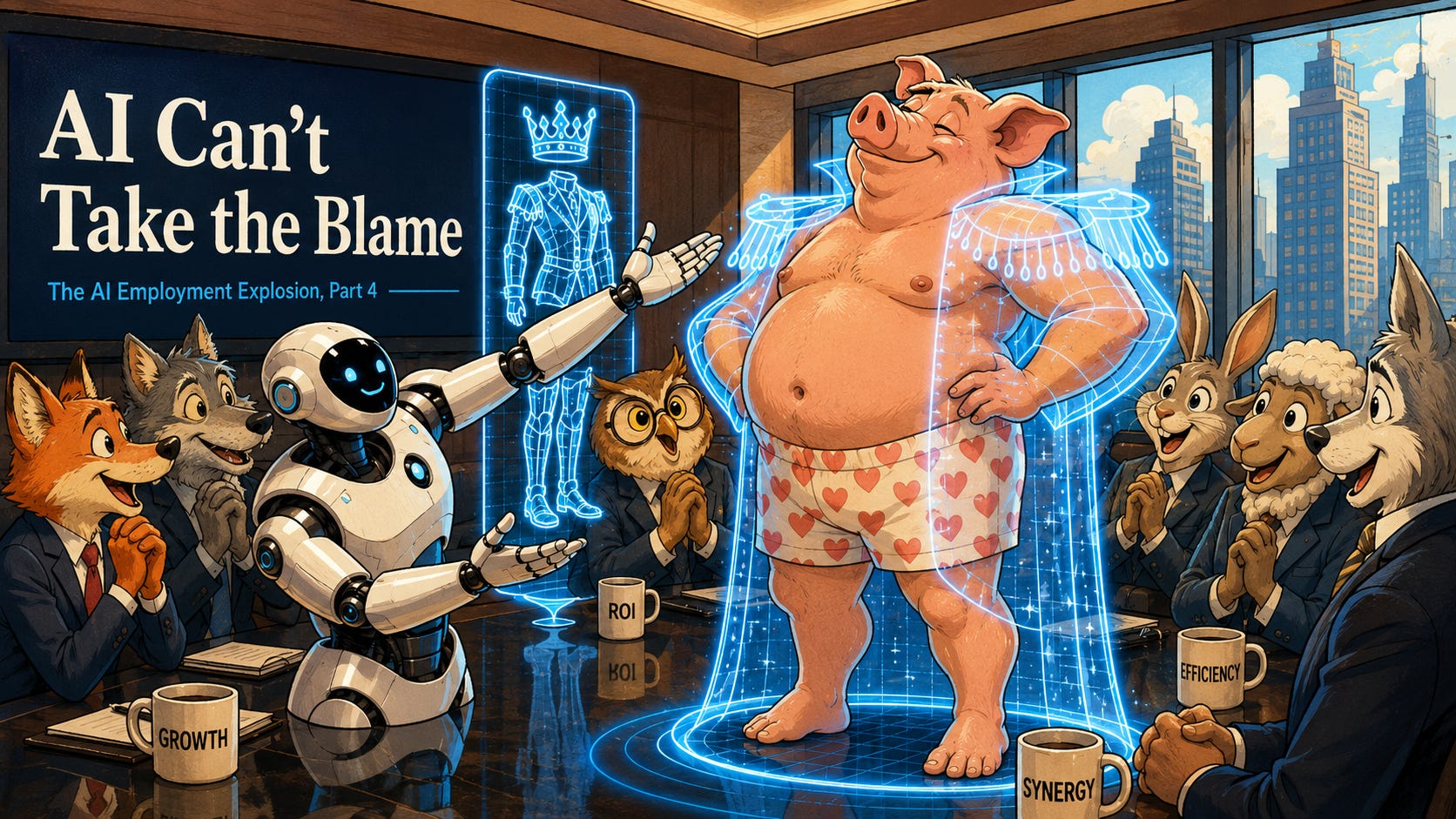
Ever heard the story of “The Emperor’s New Clothes”? Probably. But just in case you need a refresh, I’ll summarize it for you.
A scammer convinced an emperor that he was wearing the finest linen in all the land, but in reality, he was naked. The emperor was surrounded by a bunch of “yes-men,” so they told him how stylish he looked to inflate his ego. With great pride, the emperor paraded through town to show off his finest clothes. But then a small child yelled, “Mommy! The Emperor has no clothes!”
Invisible Clothes
For centuries, business owners have tried to come up with clever ways to legally “clothe themselves.” They invented the corporation so members could come and go, but the business would persist. Then they added liability protections for investors and business owners. Sometimes the clothes cover things up, but not always.
The company can always get sued and may even go out of business for it.
If a company employee commits a crime, even under the cover of a corporation, they still go to jail.
The corporate veil can be “pierced,” and the CEO can have their personal assets taken.
Now many people are under the illusion that AI functions like a magical corporation that shields the owner from criminal and civil lawsuits. And that couldn’t be further from the truth. In fact, AI is far more “naked” than traditional corporations.
The AI’s Owner Is on the Hook
We do not live in a world where AI is legally considered a person like a corporation. AI is treated as a tool.
Air Canada’s chatbot hallucinated a refund policy, and they had to honor it. 1
In Mata v. Avianca, lawyers submitted legal precedents that ChatGPT invented. They were fined $5,000. 2
iTutorGroup was sued for age discrimination caused by the algorithm in its hiring process and settled for $365,000. 3
Did the AI make these mistakes without the company’s knowledge? Probably. Did it matter? Not at all. The company owns the tool and is responsible for it.
What if the AI Becomes a Corporation?
So far, that hasn’t happened yet. But theoretically, you could make a corporation and put an AI in charge of running it. Maybe. But even if that happened, who would ultimately be responsible? The humans who set the whole thing up. If the AI did something criminal, illegal, or unethical, it would all come back to humans. The humans are in the loop even if they don’t want to be… especially when they don’t want to be!
What Does This Mean for AI and Jobs?
If a CEO thinks an AI can be accountable for itself, then they are the emperor wearing new clothes. The AI salesmen have lied to them and convinced them that they’re wearing a cool suit, but in reality, they’re naked. And you never want to be naked when the crowd is looking and you’re dragged to court.
A human will always be held legally and financially responsible for whatever AI does. The AI can never be the final accountability layer, which means a human must take on that responsibility. Welcome to the AI Baby-Sitters Club!
Final Word
Can you see any legal way for AI to run itself without a human being held accountable? Comment below!
“The buck stops here.” — Harry S. Truman
Disclaimer:
The information in this publication is for educational purposes only and does not constitute financial, investment, or legal advice. Always do your own research before making any financial decisions. Cryptocurrency investments carry risk, and past performance is not indicative of future results. I actively invest and trade in the crypto markets, and my personal portfolio and holdings change frequently. Nothing I share should be interpreted as a guarantee of performance or a recommendation to buy or sell any asset.
https://www.forbes.com/sites/marisagarcia/2024/02/19/what-air-canada-lost-in-remarkable-lying-ai-chatbot-case/
https://www.nytimes.com/2023/05/27/nyregion/avianca-airline-lawsuit-chatgpt.html
https://www.reuters.com/legal/tutoring-firm-settles-us-agencys-first-bias-lawsuit-involving-ai-software-2023-08-10/