


It was the year 49 BC and Rome was in the middle of a civil war. Julius Caesar commanded tens of thousands of Roman soldiers as he fought Pompey for control of Rome. In a few short years he won the civil war and became the most powerful man in the Roman world. 1
It’s a grand story, and it’s impressive to think about a man being in charge of tens of thousands of Rome’s finest soldiers. But Julius never directly commanded tens of thousands of men. Nobody can possibly pay attention to such a large group of people and make sure everyone is doing what they are supposed to do.
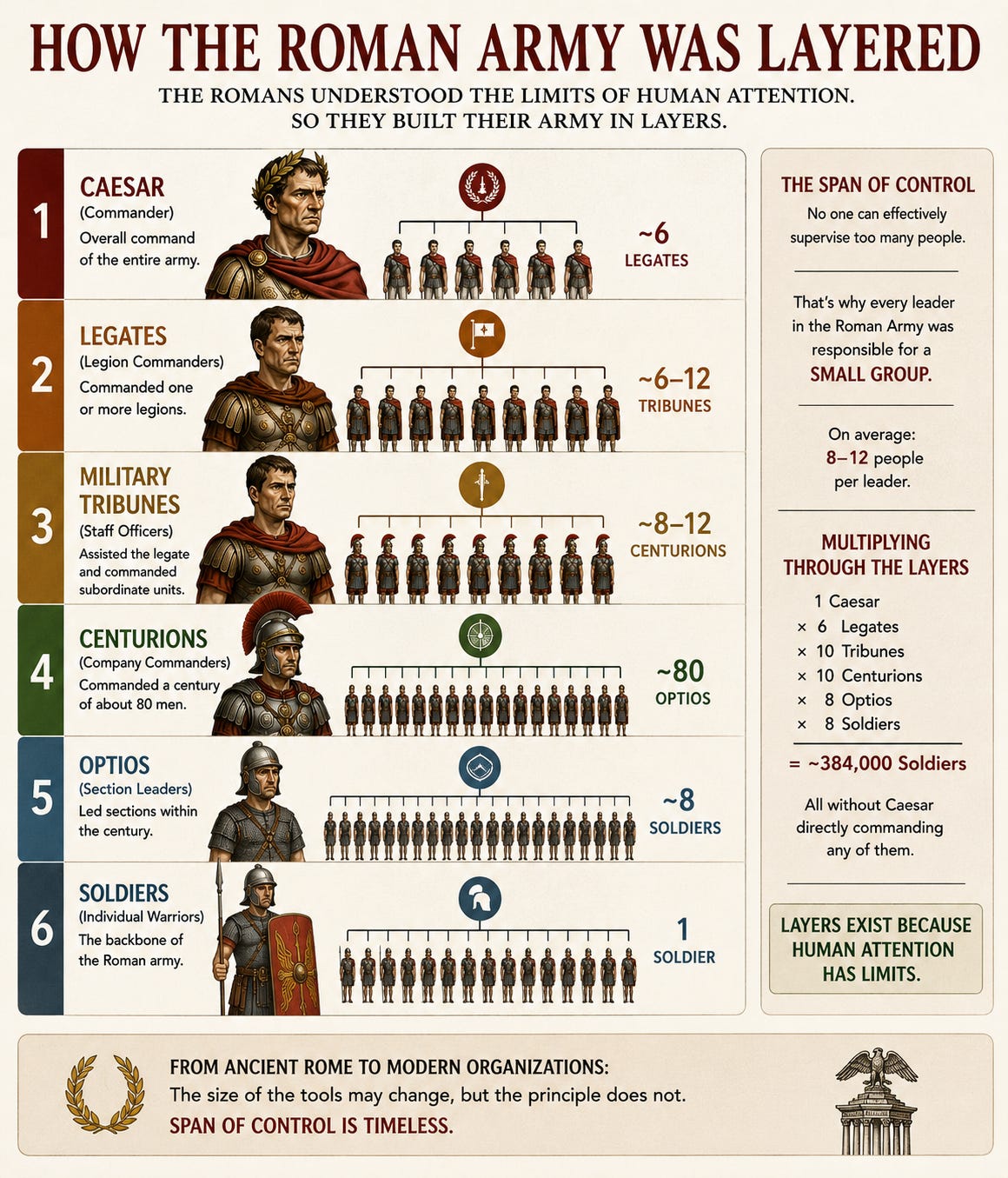
Instead, the Roman army functioned through layers. Most leaders were directly responsible for eight people. Those leaders reported to other leaders who were responsible for eight people of their own. Down the ranks it went. 2
Ancient militaries (and modern militaries) understood something important: there is a limit to how many people one person can effectively supervise. The military even has a name for it: span of control. 3
Nobody can keep track of 1,000 people.
So why would keeping track of AI agents be any different?
Overseeing AI
AI agents will perform a wide variety of tasks that humans used to do. But as my previous articles pointed out, they will still require human supervision. Every decision an AI makes ultimately falls on a human being or human organization. If an AI causes harm, the AI won’t be sued. The company will. That’s why people will monitor AI agents and make sure they aren’t making harmful decisions.
Welcome to the AI Baby-Sitters Club.
Here’s the trillion-dollar question. How many AI agents can a human babysit?
The Roman army believed the average person could only keep track of about eight people. Modern militaries reached a similar conclusion. But soldiers are just one example. Let’s look at a few other professions.
Nurses generally shouldn’t manage more than six patients at a time. In intensive care units, the ratio is often one nurse for every one or two patients. 4
Air traffic controllers typically monitor fewer than 40 aircraft at a time, and even that depends on the complexity of the airspace. 5
A cybersecurity analyst can only investigate a couple dozen meaningful alerts in a day before important threats start slipping through the cracks. 6
A lot of this depends on complexity, responsibility, and the volatility of the situation. But nobody is managing hundreds of things at once. For AI, the real question is not how many agents a person can supervise. It is how many tasks they can oversee.
For instance, a single programmer working on a single project is not monitoring 100 AI agents. He is only monitoring the updated code. But imagine 100 AI agents at a payments company each deciding whether to release transactions that tripped a fraud flag. One person could never effectively oversee that many interactions, especially when one mistake is catastrophic.
Here’s the point. Humans can only supervise so many AI agents. Infinite scale is impossible because human attention is finite. Therefore, many people will be required to monitor AI to guarantee legal compliance and good results.
There will never be a company run by 1 million AI agents with one guy in charge of them.
Objections
At this point, many tech bros and AI doomers are probably yelling at me.
Here are the most common objections.
1. AI Will Manage AI
At first this sounds plausible and it can prevent some mistakes. One model can flag another one for sloppy reasoning. They are trained on similar data and built using similar techniques. And the data they have access to is limited even if it seems like a lot. Yes, they will have tools to give them more data but language can only provide so much information.
They will make the same mistakes because they lack information that nobody can provide them.
If one AI agent reaches the wrong conclusion, there is a good chance the others will too. Putting AI in charge of AI doesn’t solve the problem if they all fail the same way.
2. AI Tools Will Scale How Many Tasks One Person Can Monitor
I think there is some truth to this, but it still has a ceiling. Air traffic control has wonderful tools. Nobody is watching 1,000 planes at the same time. Cybersecurity analysts have tools built for the digital age, and they still get alert fatigue when too many notifications start popping up.
I would argue even further that, depending on the task, AI will be more complicated to monitor than a cybersecurity notification or a plane’s flight path. The tools help, but they have limits.
3. Deterministic Systems Will Keep AI From Failing
Depending on the task, this may be true. But if the AI gets shut down by a deterministic process, a human will still have to investigate why. That sounds like something that could easily create alert fatigue.
But I have also noticed that AI can fail in unpredictable ways. The AI could be wrong enough to cause problems, but not wrong enough to trigger an alert.
4. AI Will Only Need to Be Sampled
At many call centers, a supervisor will listen to 2-5% of an employee’s calls and then assume they know whether that employee is doing a good job. 7 This allows management to scale the number of workers they can oversee without needing a large number of managers. Why not do the same for AI?
If the task is low risk, this will work. But if it’s something where a single failure could result in a million-dollar fine or loss of life, then this process can never be implemented.
5. AI Super Intelligence Will Make Monitoring Pointless
Maybe. But this objection is loaded with unspoken assumptions, and for humans to leave the loop, every one of them must be true.
AI superintelligence is possible.
AI superintelligence will be accepted by human civilization.
AI superintelligence won’t need accountability.
AI superintelligence won’t make mistakes.
AI superintelligence will be so far beyond humanity that we won’t be able to question it.
I will also point out how high the bar is for AI to completely eliminate monitoring. Its stupidest moment would need to be smarter than a team of humanity’s greatest minds. At that point, we are no longer talking about artificial intelligence. We are talking about a god in a machine.
But I also must ask who’s responsible for the ASI? If it does make a mistake who is liable? Legally machines never are.
Conclusion
As AI expands its role, so will the need for humans to monitor it. The legal necessity of monitoring will not go away, and neither will the limits of human attention. The human brain hasn’t changed since Caesar crossed the Rubicon.
Final Word
Humans are going to stay in the loop.
“Appoint them as officials over thousands, hundreds, fifties and tens. Have them serve as judges for the people at all times, but have them bring every difficult case to you.” — Exodus 18:21-22
Learn AI
AI won't take your job. But someone using it might.
Make sure you're the one. Inside the Crypto Confidence Skool community you'll learn to use AI, vibe code, and write prompts that get results. Join Crypto Confidence and be on the right side of the AI revolution.
Disclaimer:
The information in this publication is for educational purposes only and does not constitute financial, investment, or legal advice. Always do your own research before making any financial decisions. Cryptocurrency investments carry risk, and past performance is not indicative of future results. I actively invest and trade in the crypto markets, and my personal portfolio and holdings change frequently. Nothing I share should be interpreted as a guarantee of performance or a recommendation to buy or sell any asset.
https://www.britannica.com/biography/Julius-Caesar-Roman-ruler/Break-with-Pompey-and-the-collapse-of-the-triumvirate
https://www.tastesofhistory.co.uk/post/a-century-equals-eighty
https://www.ingentis.com/en/knowledge/span-of-control/
https://nevadastate.edu/son/rn-bsn/nurse-patient-ratio-laws-why-are-they-important/
https://www.nationalacademies.org/read/13022/chapter/3#14
https://www.prophetsecurity.ai/blog/soc-capacity-modeling-how-many-alerts-can-your-team-really-handle
https://www.qualtrics.com/articles/customer-experience/call-center-quality-assurance/