

The AI Employment Explosion, Part 2
The Law Will Keep Humans in the Loop

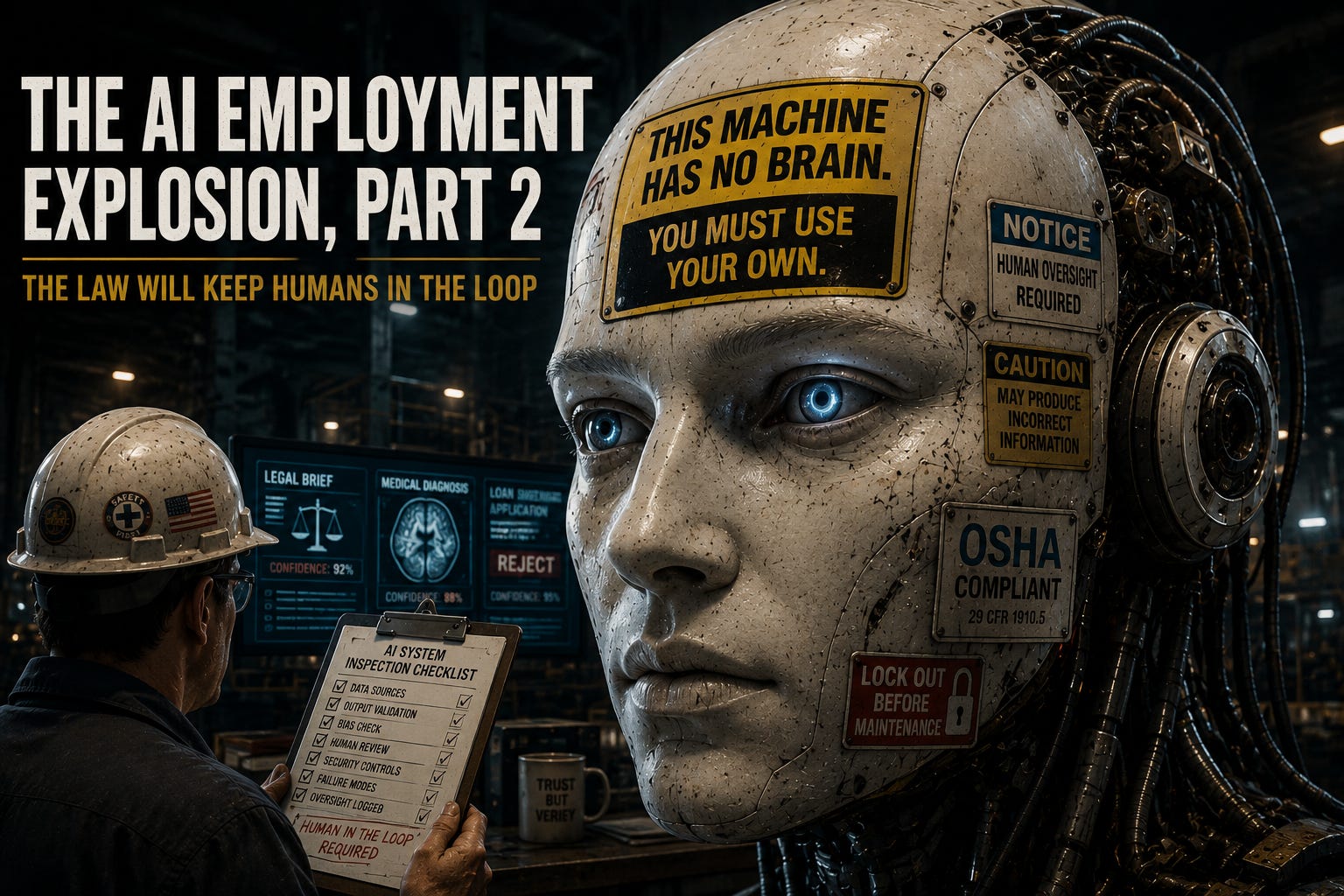
When I worked on the oil field in North Dakota I was told every safety rule is written in blood. The work was dangerous; I worked in -20°F weather, drove a semi truck on narrow roads with steep cliffs and worked with high pressure equipment up to 10,000 PSI. Because the industry is dangerous it is highly regulated. There was mandatory training, mandatory equipment (PPE) and mandatory procedures. All of it existed to prevent loss of life.
I later worked for BP and did a short stint with offshore drilling in the Gulf of Mexico. I shook hands with guys who had been on the Deepwater Horizon when it blew up. I learned that the incident had nothing to do with the crew on the rig and everything to do with engineers and company leadership off the rig.
In September 2009, the Deepwater Horizon set a world record by drilling the deepest well in human history at 35,050 feet. 1 It had an excellent safety record with few incidents and it was the crown jewel of BP. Deepwater Horizon drilled world record wells for nearly ten years and then it exploded, becoming the worst maritime oil spill in history. Eleven people died and seventeen others were injured. Its previous safety record didn’t matter. 2
Every new regulation that followed was written in blood.
The old regulator Mineral Management Services was split into 3 organizations. 3
New well control rules were implemented.
New safety and environmental systems were put in place.
Permitting for a new well became tougher.
And a temporary halt to all deep water drilling took place.
Regulations Follow Disasters
AI is a powerful tool, but it behaves differently than traditional software. It is capable of inventing information and when it is wrong it's gloriously wrong. The dangerous part is that AI sounds just as confident when it makes a mistake as it does when it's correct.
Many people believe AI agents will operate with zero human supervision. But history shows the opposite. When industries cause major financial losses, environmental disasters or loss of life, governments step in and force new oversight, regulations and mandatory procedures.
In fact, AI has already caused problems in several industries and governments are already responding with fines, lawsuits and regulation.
In the legal case of Mata v. Avianca the attorney suing the airline used ChatGPT to do legal research. The AI made up several precedents and the attorney was forced to pay a $5000 dollar fine. It was ruled that if AI makes a mistake it’s still on the attorney to get the information correct. 4
Air Canada’s chatbot invented a bereavement refund policy and the airline was forced to honor it. 5
Amazon’s AI recruiting tool had to be scrapped after the company discovered it was biased against women. 6
None of these incidents are as bad as the Deepwater Horizon explosion, but they point toward the same pattern: financial loss, lawsuits and liability for companies that rely on AI agents. A chatbot making up a refund policy is one thing. An AI system hallucinating legal precedents is another. But what happens when similar failures hit hospitals, oil rigs or nuclear power plants? Industries where people die when things go wrong do not reduce oversight after disasters. The regulations that follow are written in blood. They respond with more regulation. AI will be no different.
Welcome to the AI Baby-Sitters Club.
Conclusion
Humans won’t just oversee AI systems; it will be legally mandated. In fact, some industries may become aggressively anti-AI. I think that attempt will ultimately be thwarted, but industries like medical and legal will require massive amounts of human oversight to make certain AI is making the correct decisions.
As AI spreads through society, humans will not just remain part of the loop. The law will require it.
Final Word
AI won’t be above the law.
“Trust, but verify.” — Ronald Reagan
Join Crypto Confidence
If you’re thinking about where all of this is going, you’re not alone. One of the biggest shifts happening right now is that understanding these systems is becoming a skill in itself. That’s a big part of what I focus on in Crypto Confidence, where I teach people how to actually use AI and crypto instead of just reacting to them.
If you want to learn how to operate in this new world, you can join Crypto Confidence here.
Disclaimer:
The information in this publication is for educational purposes only and does not constitute financial, investment, or legal advice. Always do your own research before making any financial decisions. Cryptocurrency investments carry risk, and past performance is not indicative of future results. I actively invest and trade in the crypto markets, and my personal portfolio and holdings change frequently. Nothing I share should be interpreted as a guarantee of performance or a recommendation to buy or sell any asset.
https://www.gim-international.com/content/article/deepwater-horizon#:~:text=The%20Deepwater%20Horizon%20drilling%20rig,vertical%20depth%20of%2010%2C683%20metres.
https://www.cnn.com/2015/04/10/us/gallery/deepwater-horizon-victims
https://www.doi.gov/news/pressreleases/Interior-Department-Completes-Reorganization-of-the-Former-MMS
https://law.justia.com/cases/federal/district-courts/new-york/nysdce/1:2022cv01461/575368/54/?
https://arstechnica.com/tech-policy/2024/02/air-canada-must-honor-refund-policy-invented-by-airlines-chatbot/
https://www.reuters.com/article/world/insight-amazon-scraps-secret-ai-recruiting-tool-that-showed-bias-against-women-idUSKCN1MK0AG/