

Surviving Fiat’s Fall: The Case for Bitcoin
How Bitcoin Protects Your Savings When Fiat Currency Collapses

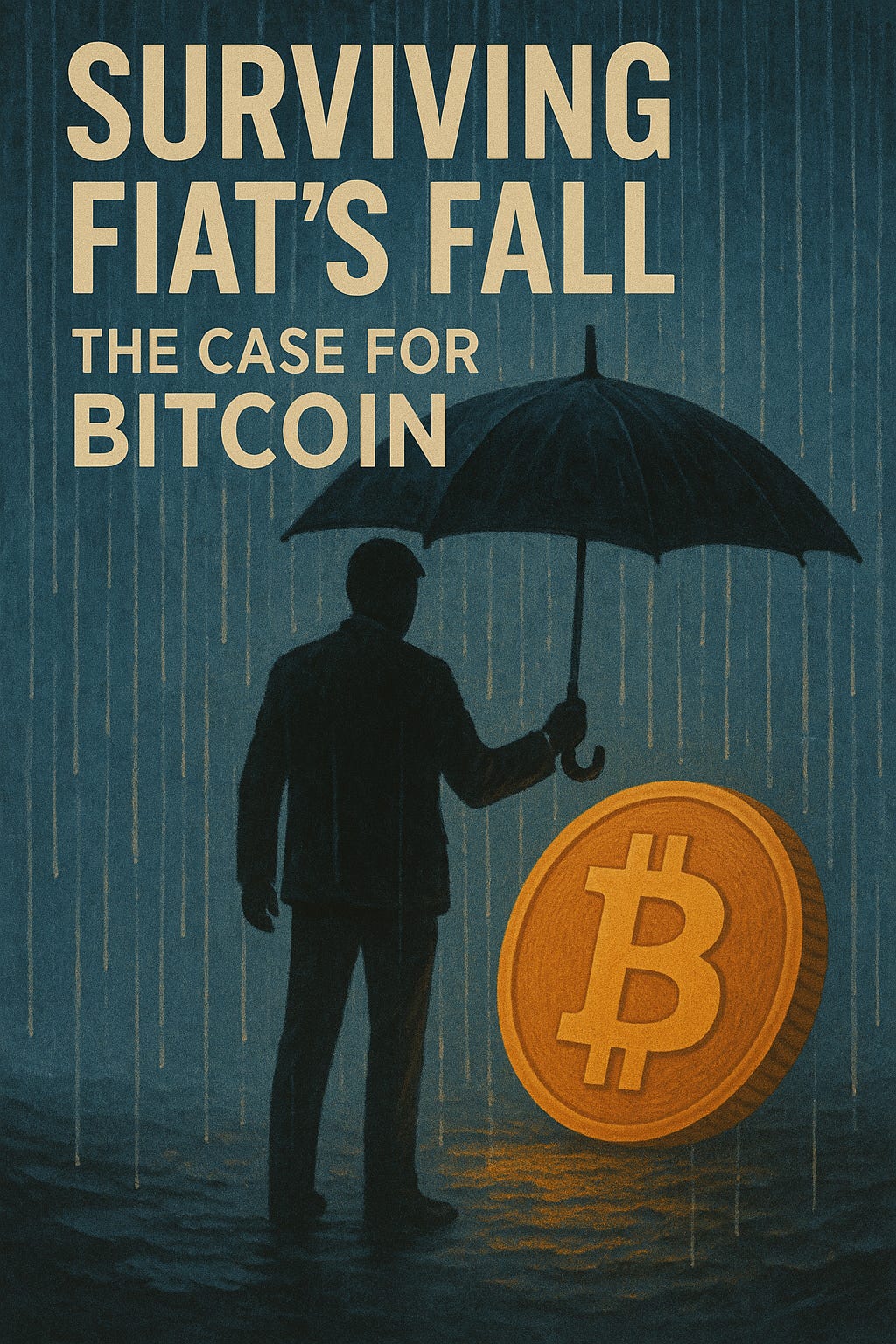
Carry An Umbrella
Weather is unpredictable. You look up and there’s not a cloud in the sky. Three hours later, you’re soaked to the bone. It always seems that when I leave home without an umbrella it rains, but when I bring one I just look like a schmuck carrying it around. But that’s life. And that’s how I see Bitcoin, an umbrella for when the fiat thunderstorm hits.
Just because you haven’t experienced hyperinflation doesn’t mean it’s rare. If you were born in 1925, lived 100 years, and were born in a random country, there’s about a 50% chance you experienced hyperinflation at some point in your life. And by hyperinflation, I don’t mean high inflation; I mean an eye-watering collapse of 50% of your purchasing power every month. 1 In events like these, even the rich and powerful can lose their life savings. But what if you didn’t have to?
To protect your life savings, you need an umbrella. That means you can’t rely on your fiat currency to stay stable. Instead, you should own assets that can weather a currency collapse and serve as replacement money when the fiat show ends. The traditional umbrella has always been gold, but I prefer Bitcoin. Here’s why I think you should choose Bitcoin as your umbrella for fiat.
Why Bitcoin?
Bitcoin has many different qualities to it that make it a superior store of value to gold, fine art, and traditional stocks and bonds; especially in a hyperinflation scenario.
21 Million Coin Limit. The only way for more coins to be created would be if the entire Bitcoin community agreed to change that limit. If any institution tried to force an “upgrade” that increased the supply beyond 21 million, it would cause a hard fork, 2 and the majority of users would likely remain with the original chain that honors the 21 million cap. This 21 million limit makes Bitcoin scarce and difficult to manipulate; perfect for a fiat umbrella.
Digital. This gives Bitcoin a massive advantage over gold. 3 Because it’s digital, you can use it for online purchases, international business, and easily take it with you to another country. Moving gold overseas is difficult and expensive, and doing online transactions with it introduces counterparty risk. In a hyperinflation scenario, you’ll still want to make online transactions, but physical gold can only be used in person.
Censorship Resistant. In a hyperinflation scenario, governments often try to prevent money from leaving the country and force citizens to use their failing currency. 4 Bitcoin is designed so that anyone with a non-custodial wallet (and these are free) can send and receive payments directly. It would be difficult for a government to stop you from moving Bitcoin across borders during a currency collapse. This censorship resistance comes from self-custody because when you control your own wallet you never have to trust a third party to hold your Bitcoin.
Decentralized and Globally Liquid. Bitcoin is run by countless servers, called nodes, all over the world, and that’s why it can’t be shut down. Its decentralized nature makes it resilient and independent from any government or corporation. This also means Bitcoin is liquid in almost every country, allowing you to trade it for local currency or use it to make purchases.
Divisible. Many people look at the price of Bitcoin and say it’s “too expensive,” but Bitcoin works perfectly well for micropayments. This is because Bitcoin can be divided into eight decimal places, (0.00000001 BTC = 1 satoshi) so even if it reached one million dollars per coin, you could still make small transactions with it since one satoshi would be worth about one penny. And if Bitcoin ever became worth too much, it wouldn’t be difficult for the network to add more decimal places if needed.
All of these features make Bitcoin resilient and useful in a hyperinflation scenario.
Practical Next Steps
Even if you think it’s unlikely that your currency will hyperinflate, you should still own a little Bitcoin to protect yourself. The biggest obstacle most people face is learning how to use noncustodial wallets and how to buy Bitcoin safely. If you need extra help, consider joining my Crypto Confidence School, where I teach newcomers how to use crypto step by step.
The first thing you should learn is how to use an exchange like Coinbase to buy Bitcoin. But that’s not the final step. Many users stop there and leave their Bitcoin on Coinbase, but this carries counterparty risk. While Coinbase is a reputable exchange, in a hyperinflation scenario, all bets are off. If a government becomes desperate, it might try to confiscate digital assets to fund its military, pay employees, or keep failing programs afloat.
This is why you should withdraw your Bitcoin and move it to a noncustodial wallet that you control. Governments can easily seize coins from companies that act like banks, but it would be nearly impossible to go door to door and confiscate Bitcoin from individual wallets. Millions of people already use non-custodial wallets, which makes door-to-door confiscation both impractical and politically unpopular. It’s hard for people to sympathize with a government kicking down their neighbor’s door over a few satoshis. For that reason, widespread confiscation is highly unlikely, and holding your own wallet protects your wealth far better than leaving it on an exchange.
Even if you never experience hyperinflation, Bitcoin is one of the smartest ways to protect and grow your wealth in uncertain times.
Final Word
Thank you for your continual support!
Inflation is taxation without legislation. — Milton Friedman
Disclaimer:
The information in this publication is for educational purposes only and does not constitute financial, investment, or legal advice. Always do your own research before making any financial decisions. Cryptocurrency investments carry risk, and past performance is not indicative of future results. I actively invest and trade in the crypto markets, and my personal portfolio and holdings change frequently. Nothing I share should be interpreted as a guarantee of performance or a recommendation to buy or sell any asset.
https://www.cato.org/commentary/hankes-inflation-dashboard-medias-misreporting-hyperinflation?
https://www.investopedia.com/terms/h/hard-fork.asp
I want to point out that I’m not saying you shouldn’t own gold. If you have some gold coins tucked away, keep them. Gold will hold its value and help preserve your wealth if your currency collapses. But don’t rely on “paper gold” to protect your savings because it carries too much counterparty risk. You don’t want to find out the truth about your institution’s honesty during a crisis. In a fiat collapse, you need an umbrella you can actually hold. And if you ever face a situation where internet or electricity become unreliable, physical gold could still be useful for making purchases.
https://www.imf.org/-/media/Files/Publications/WP/2023/English/wpiea2023067-print-pdf.ashx
Great job here! Great introduction 🍊
I would personally just truly recommend any other exchange than coinbase… “reputable” is a strong word … and there are other options. It may work well for many or has in the past but IMO I would really recommend other exchanges :-)
Thanks for the informative content , I'd love to see deeper contents as well , I'm sure they are on the way too. I'll follow your newsletter